---



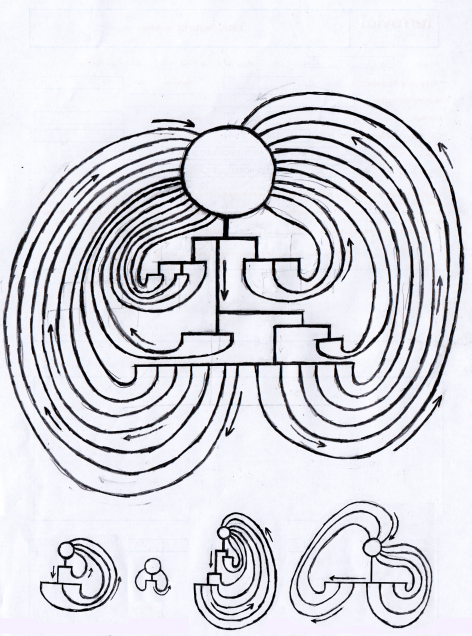
This is an ongoing project that explores and begets algorithmic-like methods of analysis of our political institutions and social interactions which aims to expand our perception of the material body of society, something increasingly enormous and simultaneous, and too big for us to grasp consistently.
We try to produce some graphics through which the structural composition of social situations could be recognised and conveyed reliably among people, so, potentially, undesirable situations could be pointed out and citicised.
This may appear a little bit of an outlandish effort in a post-structuralist dominated field such as Visual Arts, in wich the limitations of any geometrical/mathematical aproach would be the focus instead it's of it's descriptive potential, but I am still faithful that the practical power of positivist representation may convince us that we could still use a structural analysis to complement our consciousness of the intricate networks that compose our society, further more, i believe that expanding the common-sense language of political analysis may help us break out of our current ideological stallmate.


---
"Who were they, what social groups did they come from, what kind of students and people were they? How and why did they change so much in less than a year? Why did neither I nor a majority of my fellow students succumb to this phenomenon and process? Many such questions fluttered through our heads then. (...) They gave the impression of possessing some secret knowledge."
Andrew M. Lobaczewski (unconventional theorist), 1984.
"Let's be simple and bluntly honest about it, left or right, conservative or liberal, broadcast politics are dumb, dumb, dumb"
Jimmy Wales (Wikipedia's co-Founder), 2006
 / Government / THE PICTURE

The opperation that kikstarted this project that was an attempt to produce a somehow realistic institutional map of an operational Capitalist State, the case of the Catalan Autonomy in Spain, 2008 and was produced and exhibited in Barclona in 2008.
The right hand side of the picture presents the parliamentary side of Government while the left side portrays its executive branch. The bannana-shaped sections at the bottom represent the population that promptly segregates the various institutions, ultimately the Parliament. In the Center we see, as a sort of hinge, a more allegorical depiction of the judiciary and penitentiary systems, that toguether with law enforcement enclose the population defining the frontier. What is missing in the picture is the land and any phisical space making it a pure cartography of the social, showing instititions and it's associations.
As you can see, there is a more serious technical effort towards depicting the aparatus of the State using a strict cartographic code wich overlaps with a more playful attempt to add meaning in order to fully explore the possibilities of this methodology and produce a particular social critique.


------------
Political Particles...
---

---

---


---
|
|
 |


|
|

 .
.
|
|


---


---
(<BACK)
 |
|
